


Innovation collaboration in India helps seize growth opportunities
Global companies KONE and Konecranes are developing their innovation activities in India in collaboration with Demola Global and other smaller Finnish companies. Tampere University coordinates and Business Finland funds the Co‑Innovation project that generates novel market and customer understanding and enhances competitive innovations.
COFIRD
-
The project is coordinated by Tampere University, one of Finland’s largest and most multidisciplinary universities.
-
KONE is among the leading companies in the global elevator and escalator industry.
-
Konecranes is among the global leaders in the materials handling industry.
-
Demola Global is an international company that brings together higher education students and companies to develop future solutions.
-
The COFIRD consortium also includes 3D Talo Finland and Citynomadi.
-
Funding consisted of Business Finland’s Co‑Innovation funding and previously provided complementary top-up funding targeting developing markets that derived from the official development assistance by the Ministry for Foreign Affairs.
Perspectives for innovation and growth
Perspectives for Innovation and Growth series by Business Finland encourages Finnish companies to think about their growth strategies in light of long-term global developments. The series includes concise Snapshots of global trends that can shape or create future market opportunities, driving the need for sustainable renewal and innovation.
-
COFIRD is a Co‑Innovation joint project funded by Business Finland.
-
The project aims to establish a novel Finnish–Indian collaboration and co‑creation platform, tailored to Finnish needs and suited to the specific requirements of emerging and developing markets.
-
Local expertise within the project helps address local challenges while generating innovations with the potential for positive economic and social impacts.
The platform developed within the COFIRD project enables the expansion of technical expertise and research and development (R&D) activities by using a local test environment
"Many companies have global operations increasingly focused on Asia, but conducting research‑driven product development is difficult without a local presence. We create networks for companies and universities to enable development work in India", explains Markku Turunen, Professor at Tampere University, who coordinates the project.
From Business Finland’s perspective, the ambitious COFIRD project is an interesting initiative.
"It is possible to develop products and services best suited to local markets when product development expertise is partly sourced from Asia. Collaboration and networking are a specific feature of this project, and we expect the international competitiveness of Finnish companies to grow as a result of innovation activities", outlines Juha Heinola, Chief Funding Advisor at Business Finland.
With a focus on digitalization, the project leverages artificial intelligence (AI), virtual reality and digital twins. These help advance AI‑based innovation process management in elevator and escalator industries as well as in material handling in the Indian market.
Customer understanding helps commercialize scalable solutions
Building local networks and developing innovation activities in India are attractive opportunities for both KONE and Konecranes.
“India is a vast, rapidly growing market with huge business potential for KONE. Through the project, we have established an innovation team inside KONE R&D unit that is focused on local needs. Gaining a foothold in India is important for us – it is a large country and market”, says Hanna Heinonen, Digital Content Lead at KONE.
Mikael Haag, Research Funding Manager at Konecranes, describes India as a hub of engineering expertise for global companies that has long implemented technical solutions:
"We have been operating in India for a long time. We have a factory in Pune as well as several technology functions in the country. Our current goal is to expand operations so that teams there can design more comprehensive solutions and generate ideas that then further develop in Finland. This allows us to take the user experience into account already at the idea development stage and enables rapid feedback."
The initial idea was that we would develop innovations in India for the Indian market, but we quickly realized that they could be scaled globally. Mikael Haag, Konecranes
"We want to build an innovation unit and an operating model and test whether the same things that work in Finland also work in India", says Hanna Heinonen.
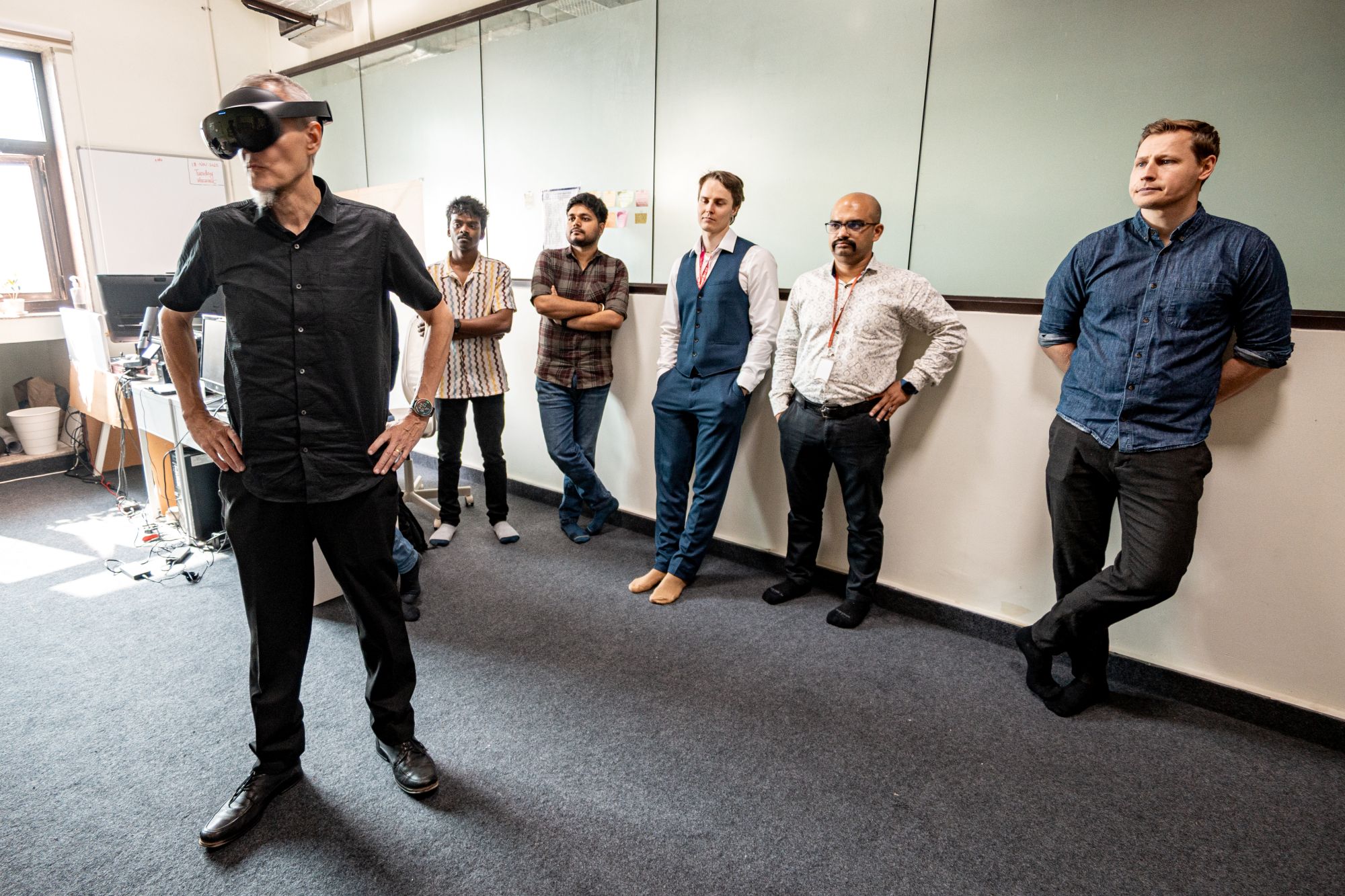
Markku Turunen with VR headgear, in the background an IIT Delhi student with Chinmay Pade (IIT Delhi), Totti Berg (Konecranes, Finland), Rajesh Nehete (Konecranes, India) and Jere Wessman (Demola).
Collaboration brings added value, and building it is like putting together a puzzle
The collaboration between Konecranes and KONE is mutually beneficial, as the companies are not direct competitors.
"We have similar use cases and we maintain close information exchanges", Haag of Konecranes explains.
"For example, the service businesses of both companies is similar, so there is no need for us to source our own subcontractors. Operations become more efficient when we don’t have to do the same things twice", Heinonen of KONE confirms.
We gain a more comprehensive view of the situation in India than would be possible through our own company alone. Hanna Heinonen, KONE
Participating company in the project, Demola Global is building a Demola innovation platform in India. The company helps KONE and Konecranes identify top talent and attracts them to take part in the collaboration.
"We are building collaboration relationships with local universities. This is not about individual projects, but about clearly repeatable processes based on different contract models and elements", explains Jere Wessman, Head of Talent Development at Demola.
"India’s potential as a rapidly growing market is enormous, but the operating environment is very different from that in Finland. The range of expertise in India is extremely broad, which makes identifying the right talent and collaboration partners even more important", emphasizes Ville Kairamo, CEO of Demola Global
The network of universities, research institutes, and companies being built in India creates a framework that can, going forward, serve companies beyond the immediate scope of the COFIRD project. The added value of the joint project lies in combining real‑world use cases with research.
"As part of the project, we have carried out pilots for which collaboration partners have been identified in India. The role of the university is to identify operating models and explore how they could be applied beyond ICT in the future", Markku Turunen explains.
Business Finland accelerates international growth
Growth in India is soaring, and the country is full of opportunities.
"Over the past decades, India has become the most populous country and one of the largest economies of the world, growing at a remarkable pace. India not only attracts foreign investments, but it has also become a home economy of global investment outflows", says Kiira Kärkkäinen, Head of International Innovation Collaboration at Business Finland.
Business Finland enables companies to conduct research and development. Co-Innovation funding promotes high-quality research and accelerates the renewal and international growth of Finnish companies, as well as the building of competitive ecosystems. Complementary top-up funding targeting developing markets and linked to a Business Finland -funded R&D project was also leveraged within the COFIRD project.
"Funding accelerates development. For example, the top-up funding enabled us to conduct an AR experiment in India: we ran a rapid sprint with a large technology company and a small, technically capable firm, allowing us to compare how they perform when tackling the same challenge and what kinds of processes they use", Heinonen of KONE explains
"Funding has been a decisive kick‑off for the project, enabling our participation on a short timeline", says Haag of Konecranes.
The local collaborations initiated through the COFIRD project have already generated ideas for Konecranes that are now being further developed within its R&D unit in Finland.