Rise to Challenge funding awarded to six of the most exciting research projects
Business Finland has awarded a total of approximately EUR 30 million in funding to six Rise to Challenge projects. The annual Rise to Challenge call funds bold research initiatives by research organisations that build expertise in future growth sectors and create long-term pathways for translating research into business.
Rise to Challenge in brief
- An annual funding call by Business Finland for projects by research organisations with identified productivity benefits and/or international commercial potential
- Aimed at breakthrough research initiatives and the creation of broadly applicable new capabilities
- Designed to generate long-term impact over 5–10 years
- The first phase of a project lasts three years. Company participation is not required at this stage; companies may become involved during the course of the project.
- Based on the results, projects may be granted continuation funding for a further two years.
Evaluation criteria for the projects
- Significance of the mission, and the uniqueness and novelty of the research idea
- Vision of the breadth of exploitation and business potential of the competence generated by the research; relevance of the resulting competence and outcomes to Finnish society
- Versatile expertise of the research group(s) in an international comparison, and the project leader’s experience and leadership capability
- Ambition level and quality of the project plan, and the plan for engaging the intended users of the results in the project
- Initial resources and RDI capabilities, and their planned development
- Development of the research project’s national and international collaboration networks
New call is open
The 2026 Rise to Challenge call is open. The deadline for submitting project ideas is 3 November 2026.
Rise to Challenge – funding call for radical research ideas 2026
“Business Finland’s mission is to accelerate Finland’s economic growth by supporting the creation of new competence and expertise. Rise to Challenge funding helps build a knowledge base with broad applicability across different industries. On the one hand, it strengthens Finland’s existing areas of expertise, while on the other, it lays the foundation for entirely new growth sectors. Most of our funding requires immediate collaboration with companies, but thanks to our increased authorisation to grant funding, we are now able to build a project portfolio that is more evenly balanced across different time horizons. Through Rise to Challenge, we give research organisations the space and resources to pursue bold new openings in the first phase without requiring company participation. At the same time, a key element of the projects is their commercial utilisation pathways, through which research results can be developed into business growth and international competitiveness,” says Lassi Noponen, Director General of Business Finland.
Rise to Challenge funding helps build a knowledge base with broad applicability across different industries. On the one hand, it strengthens Finland’s existing areas of expertise, while on the other, it lays the foundation for entirely new growth sectors.
Applications of exceptionally high quality
The 2025 call attracted 186 outline applications from research organisations, of which 32 were selected for further coaching and development. From this group, the 16 most promising projects were invited to submit full applications.
“All project proposals were of an exceptionally high standard — one could even say of an unprecedented quality. In the end, six proposals were selected for funding, with a combined value of around EUR 30 million. It is also worth noting that a new Rise to Challenge call is currently open. We are eagerly looking forward to seeing even more groundbreaking research initiatives,” says Virpi Mikkonen, Chief Innovation Advisor at Business Finland.
Funded projects
UnloQ accelerates the realisation of the benefits of quantum computing in Finland
VTT, University of Helsinki, University of Jyväskylä
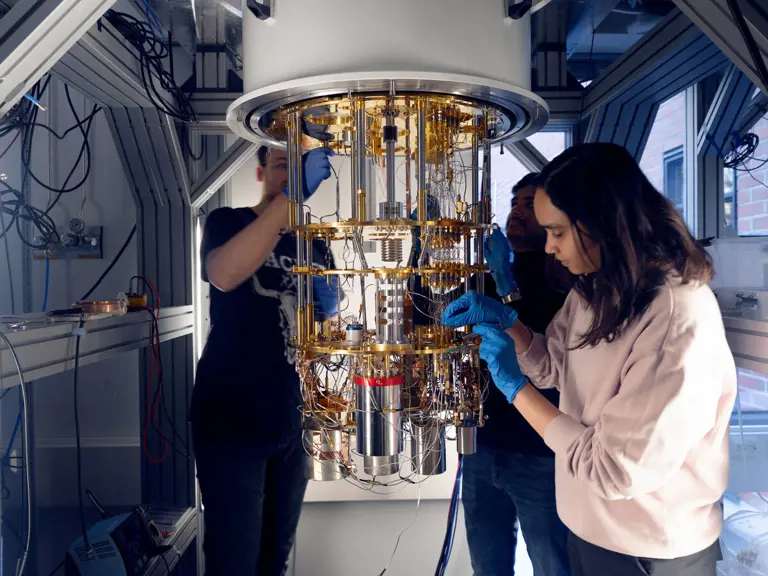
A global race is underway in the development of quantum computing. Many actors are waiting for fully fault-tolerant quantum computers before investing in adoption, which slows down innovation. UnloQ addresses this challenge by building a strategic bridge between early-stage quantum technology and industrial applications. The project brings a new, impact-driven perspective to quantum computing research by examining both how value can already be extracted from today’s noisy quantum devices and how companies can prepare for wider technology adoption in the future.
QScale develops radically new signal technology to scale quantum computers to up to one million qubits
VTT, Tampere University, Aalto University
Quantum computers are expected to enable breakthroughs in fields such as chemistry, life sciences and artificial intelligence. Industrial development of superconducting quantum computers is progressing rapidly, but current technology becomes unviable when aiming for one million qubits. The main goal of the QScale project is to develop radically new signal technology for scaling quantum computers and other quantum technologies. The aim is to commercialise the technology in the 2030s, first for controlling superconducting quantum computers and later for a wide range of other applications.
- VTT: QScale: New signal technology is being developed in Finland to scale quantum applications
- Tampere University: The QScale project is set to open up unprecedented opportunities in quantum computing
- Aalto University involved in four research projects selected for funding in Business Finland’s major call
TomoHQ creates a new level of imaging technology precision for entirely new application areas
University of Helsinki, Finnish Meteorological Institute, University of Oulu, LUT University, University of Eastern Finland, Aalto University
The project aims to achieve a completely new level of precision through multimodal measurement, opening up applications beyond those enabled by, for example, magnetic resonance imaging alone. Imaging can be carried out using inversion mathematics even from highly incomplete and low-quality measurements, making it possible to replace expensive components with more affordable ones and to develop portable devices. Mathematical methods also make it possible to perform tomographic imaging using modalities other than X-rays — for example visible light, electric currents and magnetic fields, or combinations of these. In addition, nonlinear and hyperspectral methods enhance not only the imaging of structures, but also the imaging of composition and physical properties of the target.
- Aalto University involved in four research projects selected for funding in Business Finland’s major call
- TomoHQ: Business Finland’s Rise to Challenge funding propels medical imaging and Finnish inverse problem research to new heights
- The University of Oulu receives its first Business Finland Rise to Challenge funding
Q-GEN lays the foundation for a quantum-based bioeconomy
Natural Resources Institute Finland, VTT, Aalto University, University of Helsinki
Quantum computing is expected to accelerate the solving of complex biological problems. This need spans several industries, including the forest, chemical, pharmaceutical and food sectors. Q-GEN is building a new kind of innovation ecosystem at the intersection of quantum computing, genomics and sustainable bio-based solutions. The project transforms complex biological data into concrete solutions and validates these solutions in industrial-scale environments.
- Natural Resources Institute Finland: The code of life and quantum computing come together - A groundbreaking project paves the way for the next breakthrough in the bioeconomy
- VTT: The code of life and quantum computing come together - A groundbreaking project paves the way for the next breakthrough in the bioeconomy
- University of Helsinki: The code of life and quantum computing come together – UH joins project aiming for a bioeconomy breakthrough
- Aalto University involved in four research projects selected for funding in Business Finland’s major call
RADIANT develops an AI-based materials development platform to accelerate the design, testing and deployment of new materials
VTT, University of Helsinki
Key future technologies — including energy systems, the hydrogen economy, quantum devices and sustainable industrial solutions — depend on advanced materials. Current development cycles may take 5–7 years. The goal of the project is to reduce this timeframe to just months. In its first phase, the platform will be able to produce and analyse more than 100,000 new material variations. Artificial intelligence will not only predict material properties but also guide manufacturing processes while taking manufacturability into account.
FINe-Health Foundry develops the world’s first national healthcare foundation model to improve efficiency
Aalto University, University of Helsinki, University of Turku
Fragmented health data and inefficient information systems slow down and weaken decision-making at the level of individual patients, healthcare providers and the population as a whole. The project is developing the world’s first national healthcare foundation model to significantly improve healthcare efficiency. The model enables real-time clinical decision support, patient-targeted prevention and future planning through comprehensive “what if” analyses. It can speed up medical research, reduce unnecessary treatments and support the development of evidence-based health policy.
- Aalto University involved in four research projects selected for funding in Business Finland’s major call
- ELLIS Institute Finland: A world-first nationwide AI model will boost decision-making in healthcare
- Helsinki Institute of Life Science: Rise to Challenge funding for building the world’s first nationwide foundation model for healthcare
More information
Karin Wikman
Chief Innovation Advisor
Business Finland
+358 50 5577 723
karin.wikman (at) businessfinland.fi
Virpi Mikkonen
Chief Innovation Advisor
Business Finland
+358 50 5577 930
virpi.mikkonen (at) businessfinland.fi